



 Dec 30th, 2025
•
Dec 30th, 2025
•  Gaby Gerges
If you’ve been researching car window tinting in Dubai, you’ve probably noticed that the information online isn’t always consistent. Some websites talk about 50% tint, others mention 70% visibility, while some simply describe tint as light, balanced, or high privacy.
Many drivers only realize there’s confusion when they reach a vehicle inspection or a roadside check — the tint looks fine, but the numbers don’t match what the law actually allows.
This guide clears things up in simple terms. It explains exactly what Dubai RTA allows, how tint percentages really work, why websites describe tint differently, and when exceptions may apply.
How Much Window Tint Is Legal in Dubai? (Quick Answer)
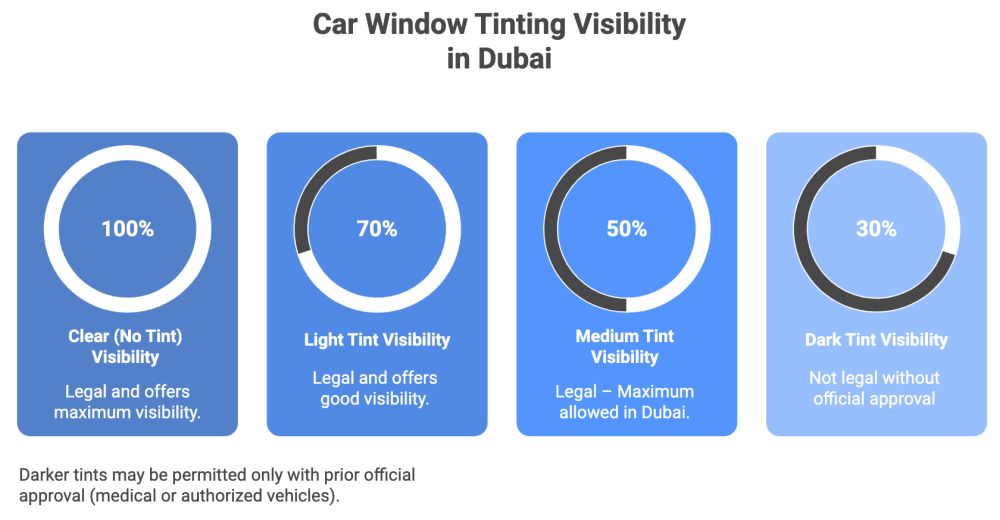
In simple terms, Dubai RTA allows car window tinting as long as the window still lets at least 50% of visible light through.
That means:
- 0% tint (clear glass) → legal
- Any tint with 50% or higher visibility → legal
- Any tint that reduces visibility below 50% → not legal
This rule applies regardless of how a website labels or markets the tint.
Quick summary:
If visibility is 50% or higher, the tint is legal in Dubai.
What Does “Tint Percentage” Mean?
Tint percentage usually refers to how much visible light passes through the glass.
Here’s how to understand it without overthinking it:
- 0% tint → clear glass, no tint
- 50% tint → half of visible light passes through
- Lower visibility → darker glass
- Higher visibility → lighter glass
From a legal point of view, what matters is how much light gets through, not how dark the window looks from the outside.
Vehicles That Are Not Allowed to Have Tinted Windows
While most private cars in Dubai are allowed to have window tinting within the legal visibility limits, tinted windows are not permitted on certain categories of vehicles.
This includes:
· Taxis
· Commercial trucks and similar vehicles
These vehicles are required to keep their interiors fully visible for safety, regulatory, and enforcement reasons.
Installing tinted windows on restricted vehicle types can result in a fine of AED 1,500, even if the tint level would otherwise be legal on a private car.
Regulations and enforcement practices may vary, and drivers should always confirm current requirements with official authorities before installing window tint.
Why Different Websites Show Different Tint Numbers
This is where most confusion comes from — and if you’ve felt unsure while comparing different sites, you’re not alone.
Tint can be explained in a few different ways:
- Visibility percentage, which focuses on how clear the view is from inside the car
- Tint percentage, which refers to how much visible light passes through the glass
- Descriptive labels like light, balanced, or high privacy, used for easier visual comparison
These descriptions may look different, but they all point to the same thing. The legal check is always the same:
Does the window allow at least 50% of visible light through?
If yes → it complies with Dubai regulations.
If no → it does not.
For example, a tint described as “70% shade” (meaning the glass blocks about 70% of visible light) typically allows only 30% visibility, which exceeds Dubai’s legal limit. This would only be permitted with prior official approval, such as a medical exemption or authorization for certain government vehicles.
Is Darker Tint Always Better?
Not necessarily.
Darker tint mainly affects privacy and appearance. It doesn’t automatically mean better performance. In practice:
- Heat reduction depends largely on film quality, not just darkness
- Very dark tints can make night driving less comfortable
- A lighter, legal tint can still provide excellent comfort if the film quality is good
This is why focusing only on how dark a tint looks can lead to poor visibility without real benefits.
How to Choose the Right Tint Level in Dubai
A practical way to decide:
- Daily driving or family use → choose tint that keeps visibility at 50% or higher
- Frequent night driving → avoid very dark tints that reduce clarity
- Comfort in hot weather → prioritize film quality while staying within legal limits
In Dubai, the safest choice is usually the one that balances visibility, comfort, and compliance.
Once you know which tint level is legal and suitable for your needs, the next step is choosing a professional window tinting service in Dubai who ensures correct film quality, accurate visibility levels, and full compliance with Dubai regulations.
Legal Exceptions to Dubai’s Window Tint Rules
While Dubai RTA generally requires car windows to maintain at least 50% visibility, there are limited and official exceptions where darker tint may be allowed.
These exceptions are not automatic and apply only with prior approval from the relevant authorities.
Medical Exemptions
Drivers with certain medical conditions that require protection from direct sunlight — such as skin sensitivity or specific eye conditions — may apply for an exemption.
To do so, you must:
- Obtain a medical certificate from a licensed health authority
- Submit a request to the Ministry of Interior (MOI) or the local police department
- Receive official approval before installing a tint darker than the standard limit
If approved, the exemption documentation should be kept in the vehicle at all times, as traffic officers may request it during inspections or roadside checks.
Government and VIP Vehicles
Certain government, security, or official vehicles may also be permitted to use darker window tints for operational or privacy reasons. These permissions are handled directly by authorities and are not available to the general public.
Installing darker tint without official approval — even for medical or privacy reasons — can still result in fines or inspection issues.
Common Mistakes Drivers Make
- Assuming higher numbers always mean darker tint
- Choosing tint based only on appearance
- Ignoring night-time visibility
- Not checking whether the tint meets visibility requirements
- Assuming exemptions apply automatically
Final Takeaway
Once you strip away the confusing labels, Dubai’s window tint rule is straightforward:
If a car window maintains 50% visibility or more, the tint is legal in Dubai.
Different websites may explain tint in different ways, and limited exceptions do exist, but the rule itself does not change. Understanding this helps you avoid fines, inspection issues, and unnecessary guesswork when choosing a window tint.
FAQ (Quick Answers)
What percentage of window tint is allowed in Dubai?
Dubai allows window tinting as long as visibility is 50% or higher.
Is 0% tint legal in Dubai?
Yes. Clear glass with no tint is fully legal.
Is 50% tint the maximum allowed?
Yes. 50% is the lowest visibility allowed under RTA rules.
Is darker than 50% tint ever allowed?
Only in limited cases with official approval, such as certain medical exemptions or authorized government vehicles.
Can I install darker tint and apply for exemption later?
No. Approval must be obtained before installing darker tint.
Why do websites show 70% or 30% tint?
Because tint can be described using visibility, tint percentage, or shade labels. Legality always depends on visibility.
Are tinted windows allowed on taxis or trucks in Dubai?
No. Tinted windows are not permitted on taxis and certain commercial vehicles, regardless of tint percentage.
About the Author
Gaby Gerges
Marketing Manager at AutoHub | CDMA Certified
Dedicated to helping UAE drivers make smarter, safer car-buying decisions.